
Check Cupertino Voter Registration
Santa Clara County runs the county tool for Cupertino registration checks. The Santa Clara County Registrar of Voters Look Up Voter Registration form asks for personal identifiers before it will search. That design matters. It is a status check for the voter, not a name directory that lets a member of the public browse all Cupertino voters.
Use the county lookup when the question is narrow: whether a registration is active, whether the county has the voter in the right place, or whether the person should contact the Registrar before an election. The California Secretary of State My Voter Status tool gives a statewide self-service path for the same general purpose. If the goal is a full voter file, the process changes to a restricted application, covered farther down.
- Open the Santa Clara County lookup and enter the voter name exactly enough for the system to match it.
- Add the requested identifying number and birthdate fields. The tool asks for these because it is not an open voter-roll search.
- Submit the form, then contact the Registrar of Voters if the result is missing, stale, or does not match the voter's current registration facts.
| Lookup Field | Input Type | Required | Format Notes |
|---|---|---|---|
| First Name | text | yes | Voter's first name. |
| Last Name | text | yes | Voter's last name. |
| Drivers License or ID | text | yes/conditional | California driver license or ID number requested by the county tool. |
| Social Security Number (Last 4 Digits) | text | yes/conditional | Last four digits requested by the county tool. |
| Birthdate | date | yes | Date of birth. |
| Go | button | n/a | Runs the lookup. |
For a visual check of the same fields, the source screenshot comes from the Santa Clara County voter-registration lookup page.
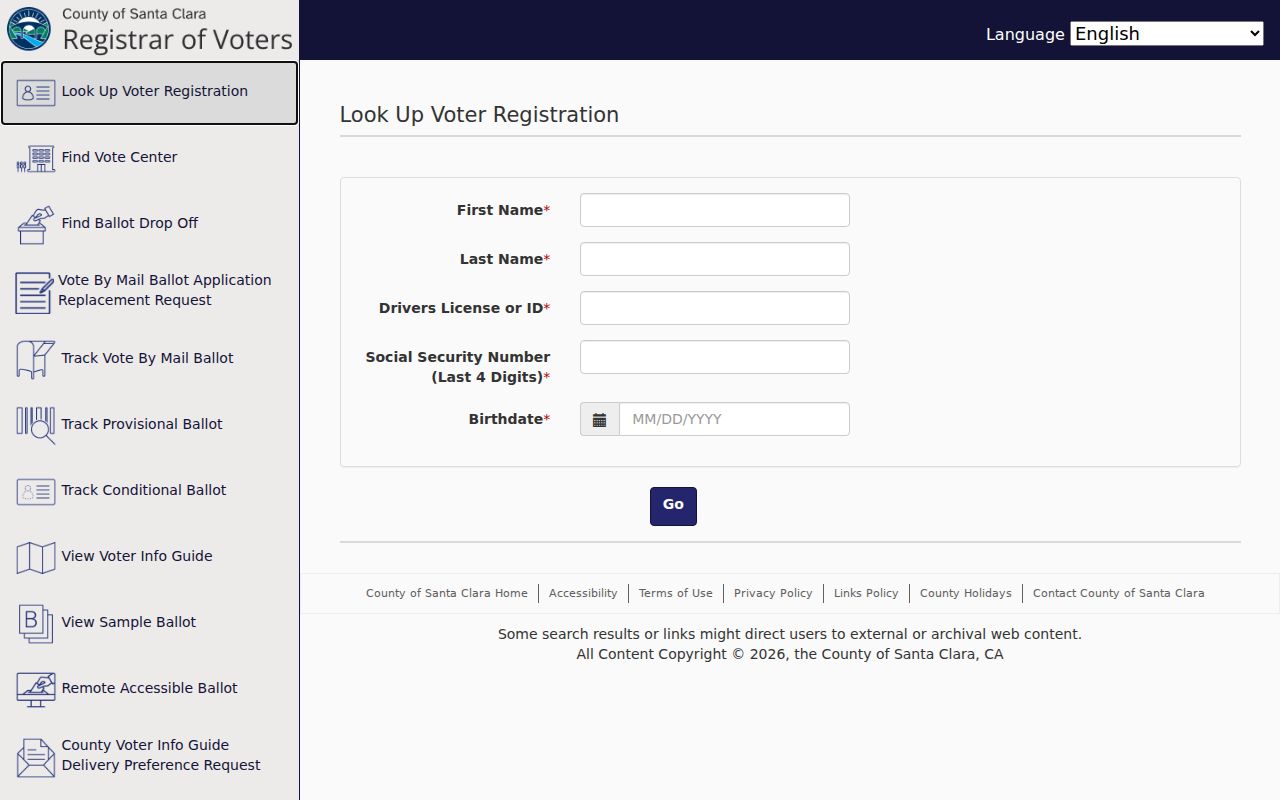
The screenshot reinforces the key limit: the tool asks for private matching details before returning a status result.
Cupertino Voter Lookup Is Self-Check
The common myth is that a voter lookup is a public people directory. For Cupertino voters, that is wrong. Santa Clara County's lookup requires the first name, last name, identifying number, and birthdate. Those fields make sense for a person checking personal registration, but they do not support casual browsing by neighborhood, surname, or address.
The broader voter rolls sit behind statutory access rules. California allows voter-file information only for purposes the Secretary of State recognizes, such as election, scholarly, journalistic, political, or governmental work. A person who wants to find an old friend, trace a relative, or confirm a civic fact should use the self-check only when they are checking their own record. Other personal research should rely on open public records, directories, archives, and direct contact with the right custodian.
Note: Cupertino voter records are official election records, but the county lookup is not a public browse-all-voters index.
What California Voter Records Show
California voter records can include more detail than the public self-check displays. The exact fields depend on access level and format. A legally supplied voter file may include identifying and election-administration fields, while the online status tool is built to answer a much smaller question for the voter.
For Cupertino voters, the important distinction is between registration facts and ballot choices. Participation history can show which elections a voter voted in. It does not show how the person voted. Party preference, precinct, district, and language preference can appear in the voter record when the requester is allowed to receive that data.
| Name | May appear in voter records and voter-file extracts for authorized users. |
|---|---|
| Residence address | May appear unless the voter is protected by Safe at Home or a court order. |
| Mailing address | May appear when a mailing address exists and disclosure is allowed. |
| Registration status | Shows status such as active or other county-maintained registration state. |
| Registration date | Can show when the registration was recorded or updated. |
| Party preference | Can appear in California voter-file data when included in the allowed format. |
| Precinct and districts | Administrative voting geography tied to the registered address. |
| Participation history | Shows elections in which the voter voted, not ballot selections. |
Confidential Cupertino Voter Records
California's public and confidential split for voter files is governed mainly by Elections Code sections 2188 and 2194 and Secretary of State rules. The split is strict because voter records can hold home-address, identity, and signature data that should not be released without legal authority. Cupertino voters should treat a voter file as a restricted election record, not as a general people-search product.
The non-public side includes full Social Security numbers, driver license or state ID numbers, signatures, and protected addresses. Date of birth data is also sensitive in voter-file access. The Santa Clara County confidential-registration channel recognizes voters who are in California's Safe at Home program or who present a superior court order.
Confidential by law. Elections Code sections 2188 and 2194 limit release of California voter-file information, and protected voter addresses are not disclosed to unauthorized persons.
The Santa Clara County confidential registration page directs eligible voters through the county process. The state Safe at Home program supplies an address confidentiality path for eligible survivors and protected persons.
Request California Voter File
A Cupertino voter file request can run through state or county election channels, depending on the requested data. The California Secretary of State voter information file request page points requesters to the state application, while Santa Clara County publishes a voter and election data purchase page for county election data.
Do not use a California Public Records Act request as a shortcut around the voter-file rules. The CPRA can be the general fallback for existing public records, but Cupertino voter records have their own statutory process. The application requires a purpose statement and a certification that the information will be kept and used within the allowed bounds.
| Request Step | What the Applicant Provides | Why It Matters |
|---|---|---|
| Applicant information | Name, organization, address, phone, and email. | Identifies the person or entity responsible for the file. |
| Type of use | Election, scholarly, journalistic, political, governmental, or other authorized use. | Shows whether the request fits California voter-file access rules. |
| Requested file | Statewide voter-file information or a specified county or format. | Defines whether Cupertino data is part of a state or county extract. |
| Purpose statement | A written explanation of the intended use. | Lets election officials assess authorized purpose. |
| Security certification | Confidentiality and storage certification. | Protects voter data after release. |
| Signature and payment | Signed under penalty of perjury; fee if charged. | Creates legal accountability and completes processing requirements. |
The voter data source image is from Santa Clara County's purchase voter and election data page.
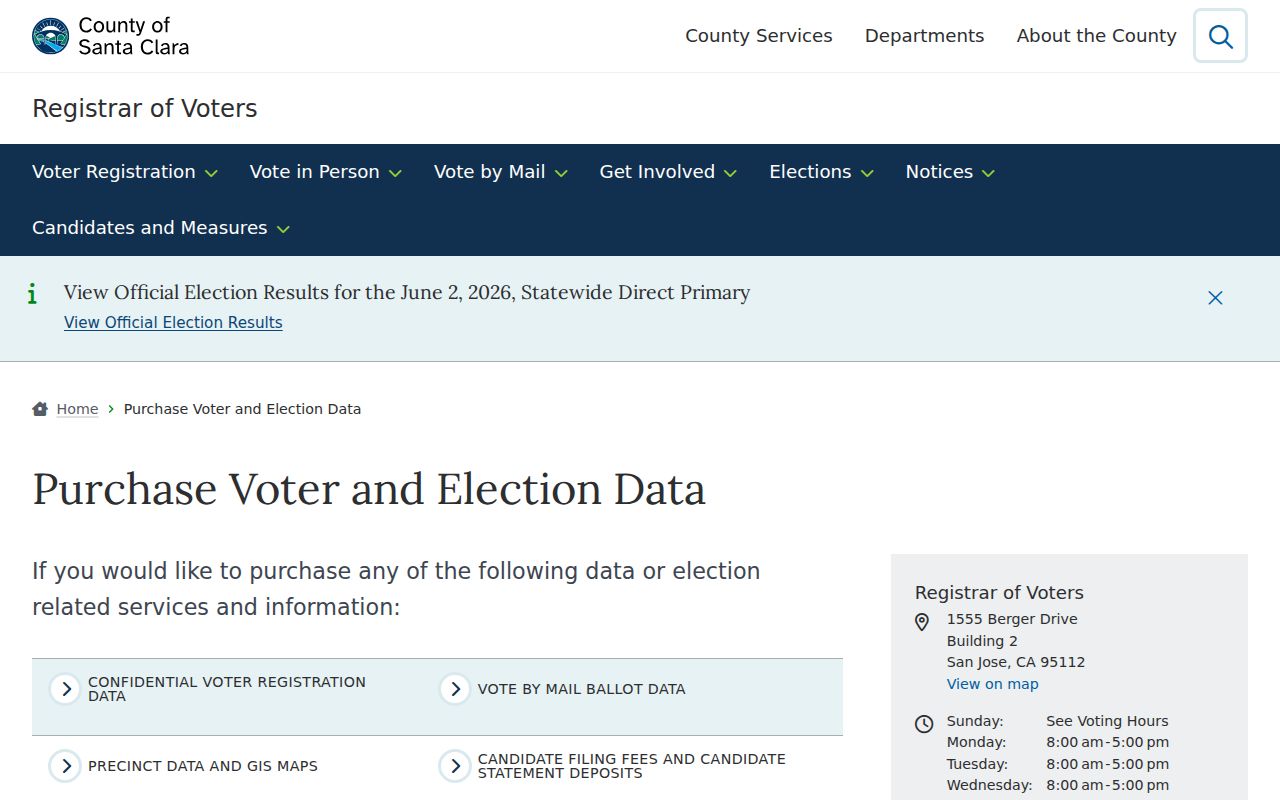
The page belongs in the access chain because county election data is handled as a controlled request, not as an instant public download.
Santa Clara ROV Contact Channels
Cupertino is served by the Santa Clara County Registrar of Voters for county election administration. Use the Registrar when the online registration lookup fails, when a voter needs to correct a record, when a protected-registration question needs staff review, or when county election data is requested through the proper channel.
Santa Clara County Registrar of Voters
1555 Berger Drive, Building 2
San Jose, CA 95112
Main: 408.299.VOTE (8683)
Toll free: 866.430.VOTE
Fax: 408.998.7314
Email: registrar@rov.sccgov.org
Mailing Address
P.O. Box 611360
San Jose, CA 95161-1360
Hours are Monday through Friday, 8 a.m. to 5 p.m., with extended election hours posted before elections.
Cupertino Voter File Penalties
The Secretary of State application warns that misuse of California voter-file information is a misdemeanor under Elections Code section 18109 and Penal Code section 19005. The warning is not boilerplate. It is the enforcement edge of the voter-file certification. A requester must understand the allowed purpose and keep the data within that purpose.
Misuse risks include using voter records to harass, stalk, dox, impersonate, or expose a protected address. Those risks are also why the county lookup is designed as a self-check. When a Cupertino voter record is needed for civic, election, scholarly, journalistic, political, or governmental work, use the formal application and keep the approval, purpose statement, and storage rules with the file.
Use limit. California voter rolls are not general commercial people-search data; the application ties access to approved purposes and criminal penalties.
Historical Cupertino Voter Records
Older Cupertino voter records need a different fallback path. The research did not locate exact official years for Cupertino or Santa Clara County historical poll books, voter registers, or precinct lists. That gap should be treated honestly. Do not assume a year range or claim that a specific run exists without confirmation from the holding institution.
For older residents and family-history work, start with the Santa Clara County Archives, the California State Archives, local genealogy societies, and library local-history staff. Cupertino incorporated after Santa Clara County's records system was already long established, so older voter and civic traces may sit under county, township, school, church, orchard community, or nearby San Jose and Santa Clara sources rather than under a modern Cupertino label.
Historical voter rolls can support genealogy, heir, and neighborhood history research when they exist, but they are only one part of the trail. Pair them with naturalization records, probate files, land records, newspapers, cemetery indexes, and local directories when a person predates modern electronic election systems.
Cupertino Voter Records Context
Cupertino voter registration records sit between ordinary public records and confidential election administration data. The status lookup is public-facing, but it is built for the voter. The voter file can be released only through a controlled path. Confidential registration protects people enrolled in Safe at Home or covered by a qualifying court order.
That makes voter records different from a deed index, a court party search, or a staff directory. Those tools may let a researcher browse by name or address. The voter-file path asks first whether the person has a right to check the status or a lawful purpose to receive broader data. For general access-law context outside this election-specific process, see Cupertino public records.